Your First Racecard: A Calm Way to Read the Page
Learn how to read a racecard by matching the race, runner and saddlecloth number, so you can follow the field without getting lost in small print.
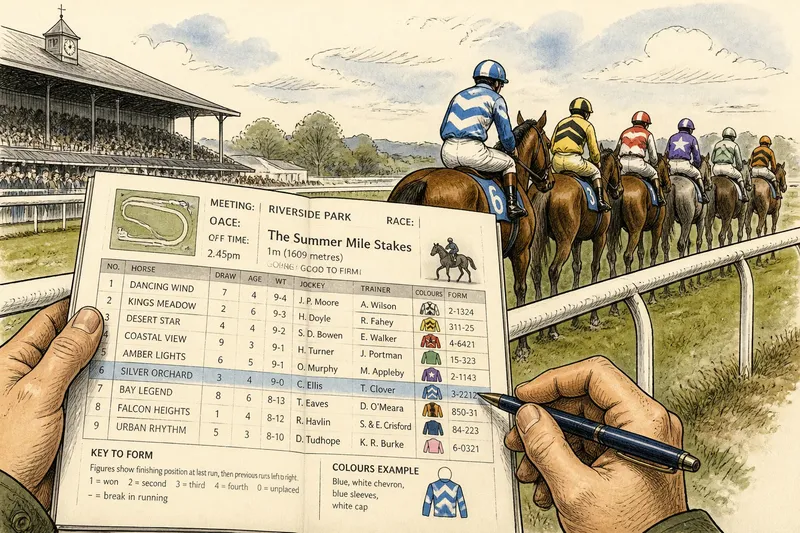
How do you read a racecard when the horses are already heading to the start? Read the racecard heading first, then trace one runner’s row from left to right. That gives you the details you need to recognise the event and follow a horse without getting bogged down in small print.
On a busy afternoon, names, colours and abbreviations can blur together. A useful route is simple: confirm the race, locate the runner, then check the card’s own key for any unfamiliar marks. You do not need to decode every line to enjoy the race.
Check the racecard heading before choosing a runner
Find the venue and race number at the top of the card. Together, they help you match the page to the event being run, particularly if you have several races or meetings in front of you. The scheduled off time and race title may also appear there.
Look for the distance and going description. The distance tells you the length of the contest; the going is the published description of the ground. Both are useful for understanding what is printed on the card, but neither tells you on its own how a particular horse will run.
Race conditions may appear beneath the heading. They describe the terms of entry, and their wording can be specialised. If a condition is unclear, keep the exact phrase in view and consult the card’s explanation or an official racecourse source rather than guessing.
Follow one runner’s row from name to colours
Racecards usually place each runner’s details on a single line or row. Start with the horse’s name and follow the same line across to the saddlecloth number, rider and trainer. Taking the row in order helps prevent a common mix-up: reading a name from one line and a rider or colour from the next.
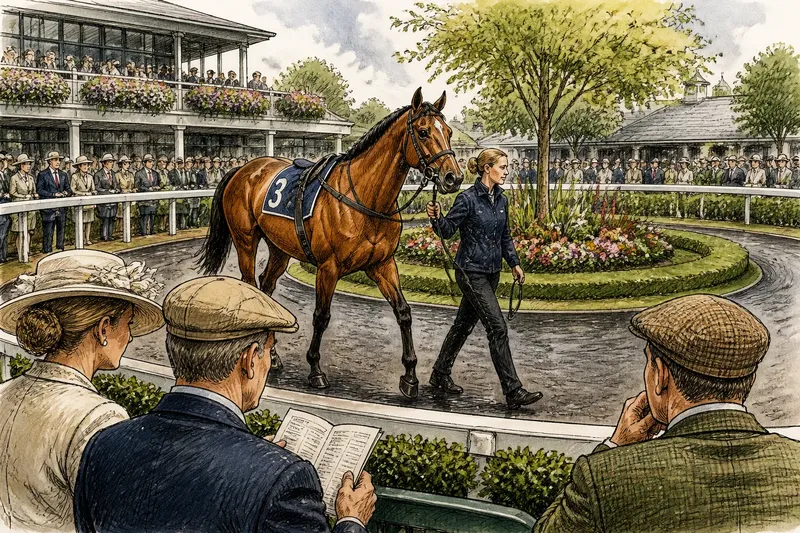
The saddlecloth number is a handy way to identify a horse as the field moves. If colours or silks are listed, use them as another visual clue. In a crowded field, colours can be difficult to pick out, so keep the number and name in mind as well.
A card may also include the draw, age, weight, headgear or breeding. These are separate details, not a single ranking. If a field is blank, the information may simply not appear in that card’s format; you can still follow the runner by its name and number.
Use the racecard key to read form marks
Letters and numbers beside a runner can summarise previous results, but their meaning and presentation may vary by publisher. Check the legend printed on the card before interpreting a mark. If the key does not explain it, leave it undecoded rather than assigning it a meaning from memory.
Some entries may include a date, course or finishing position. Those details help identify what a form mark refers to. A past result is a record of an earlier race, not a description of what is happening on the course now.
Say you are following a runner called Silver Orchard. Its row lists saddlecloth number 6, a rider named Ellis, blue-and-white colours and a string of form marks. You trace the row, note the number and colours, then check the card’s key for the marks. As the field moves, you can look for number 6 and use the colours as a second clue; if you cannot pick out the silks, return to the number rather than guessing which horse is Silver Orchard.
Use this quick racecard check to decide what to do next
- Check the venue and race number. If both match the event you mean to follow, continue with that card; if either differs, find the correct racecard before reading the runners.
- Check the scheduled off time and race title. If they match the race being called, keep the page open; if they do not, check the meeting display or current racecourse notice.
- Check the distance and going description. If both are printed, read them as details of the contest and ground; if either is missing, do not fill the gap with a guess.
- Check that the horse’s name, saddlecloth number and rider sit on the same row. If they do, use those details together; if the layout is unclear, follow the row back to its number before identifying the horse.
- Check the colours or silks listed for the runner. If they are clear, use them as an extra visual clue; if they are hard to distinguish, rely on the saddlecloth number and name.
- Check the card’s legend before interpreting a form mark. If the key explains it, use that meaning; if it does not, leave the mark unresolved and follow the details you understand.
- Check for a non-runner or a change to the declared arrangements. If the card or official display shows an update, use the current information; if the sources conflict, ask racecourse staff or check the latest official notice.
What racecard details do readers ask about?
What does the race number tell me?
It identifies the event within the meeting’s card. Read it alongside the venue so you do not confuse one race or meeting with another.
Where do I find the horse’s number?
Look for the saddlecloth number in the runner’s row. Use the same row to confirm the horse’s name and any colours shown.
What does the going description mean?
It is the published description of the ground for the meeting. Treat it as context on the card, not as a prediction about an individual runner.
What should I do with an abbreviation I cannot decode?
Check the racecard’s own key or consult an official explanation if the mark matters to your understanding. If it remains unclear, leave it open and continue with the details you can read.
Leave small uncertainties alone when the race begins
It is not worth memorising every abbreviation before you arrive. Keep the card’s key nearby, and ask racecourse staff about a practical detail that affects your plans. For a printed mark you cannot place, it is fine to move on.
Racecards can be updated after publication, including for a non-runner or a change to a declared arrangement. Check the current display or an official notice if the card and what you hear do not agree. That is more reliable than trying to infer an update from an old printout.
When the horses move, look up from the page and watch the field. If you lose sight of your runner, use the saddlecloth number and colours to find it again. Learning how to read a racecard is mostly about making those printed details work together, while recognising when the card cannot answer a question on its own.