The Form Guide Is Not a Forecast
Learn how to read a horse racing form guide, compare relevant past runs and understand what the details can—and cannot—tell you about a new race.
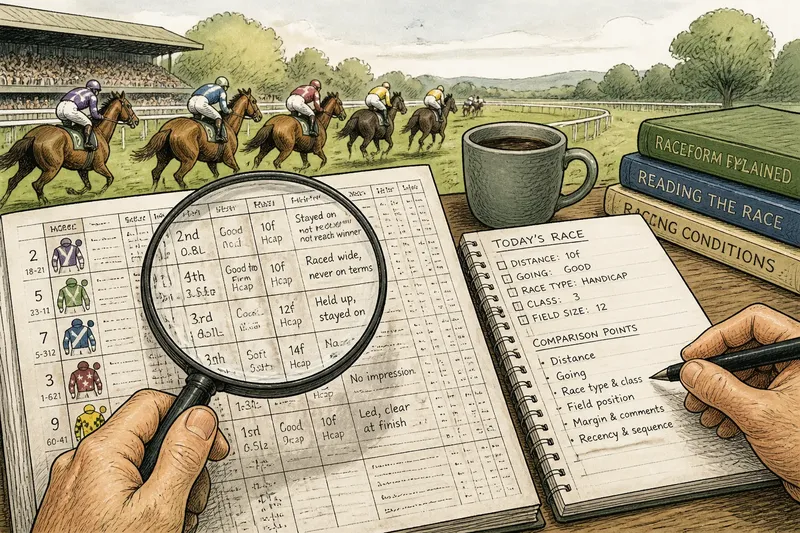
What can a horse racing form guide tell you about a runner in the next race? It records earlier performances, and the useful details are often found beyond the finishing position. Read the form to understand what happened and how those runs compare with the new task.
A form guide records results and context
A form guide is a compact record of past runs, usually including finishing positions and details such as racecourse, distance, going and race type. It can help you identify useful comparisons, but the bare result is only part of the account.
A horse that came second may have finished close to the winner or well behind. Check the margin, where available, and read any race comments. Together, these details give a clearer sense of how the result unfolded.
Race conditions shape how past form reads
Each race has its own field, pace and circumstances. A win under conditions that suited a horse may be less relevant when the next race presents a different challenge.
Imagine a horse that finishes strongly after the runners set a brisk pace. In its next race, suppose the early pace is slow and the field stays closely grouped. The previous late finish remains part of the record, but the different race shape offers less opportunity for the same kind of closing run.
A short form line may also leave out important detail. A horse might have been hampered, raced wide or struggled to find a clear path. A comment can help explain the result, but it cannot establish what would have happened under different circumstances.
Compare the details that match the new task
Focus on the features that connect an earlier run to the race ahead. A relevant comparison is more useful than a long list of unrelated finishes.
- Distance: Check the trip for each run. If an earlier race was over a similar distance, compare it more closely; if the trip was quite different, treat stamina or speed as a possible reason the result may not transfer.
- Going: Note the conditions recorded for each run. If the going matches today’s description, keep that run in view; if it differs, avoid assuming the performance will carry across unchanged.
- Race type and class: Compare the race conditions and opposition. If they are broadly similar, the result may offer useful context; if they differ substantially, give the comparison less weight.
- Field position: Look at where the horse raced when that information is available. If it led or came from behind, consider how that style fitted the race; if the guide gives no position detail, do not infer one from the finishing place.
- Margin and comments: Read the margin and any concise notes. If they describe a close finish or an incident, use that context; if notes are absent or unclear, leave the reason for the result open.
- Recency and sequence: Read the order of recent runs and the time between them. If a sequence appears relevant, compare the conditions behind it; if the runs differ, do not treat the sequence as a single pattern.
These are comparison points, not a scoring system. A close match on one detail can sit beside a poor match on another, so note both rather than forcing a single verdict.
A sequence of wins needs context
A run of wins records repeated success in those particular races. To understand what it may say about the horse, check what the wins had in common: the going, distance, race type, opposition and way the races unfolded.
If the upcoming race differs on several of those points, the earlier sequence may be less relevant. It is not worth the effort to turn every result into a complex theory; begin with the details that genuinely match the new task.
A poor finish deserves a fair reading
A disappointing finish may reflect a decline in performance, a mismatch with the conditions or an incident mentioned in the race comments. To construct a balanced interpretation, compare the run with nearby performances and note which circumstances changed.
If a horse struggled on unfamiliar going, that detail may matter when considering another race on similar ground. If the reason for a poor run is unclear, record the uncertainty rather than inventing an explanation or disregarding the result.
Use the racecard to frame a comparison
Start by asking which previous runs resemble the task ahead. Compare distance, going, race type, opposition and any useful comments. This keeps one prominent win or defeat from dominating your reading.
Say you are considering a horse with a close second over a similar trip on different going. Its earlier record also includes a placing on today’s going and an unremarkable finish over a longer distance. The close second is relevant for the trip, the older placing offers a separate comparison for the going, and the longer-distance result has limited relevance to today’s task. You have several pieces of context, not a single answer.
For official descriptions of conditions and race details, use the racecard or results information for that event. If an entry or term is unclear, check the organiser’s wording rather than guessing from the form line.
Which form-guide questions help most?
Does a previous win make a horse favourite to win again?
A previous win tells you what happened in that race, not how the next one will unfold. Compare the conditions and opposition before deciding how relevant it is.
What does a finishing position leave out?
It does not show by itself how close the horse was, how the race unfolded or whether an incident affected its run. Check the margin and comments when available, and treat them as partial context.
Are recent runs more useful than older runs?
Recent runs may reflect circumstances closer to the current race, but age alone does not determine relevance. An older run under similar conditions can still be useful, while a recent run in a very different task may tell you less.
Can a form guide identify the likely winner?
It can help you compare previous performances with the new challenge, but it cannot settle the outcome. Keep your reading focused on what the record describes and where the comparisons are limited.
For horse racing form reading, the most useful habit is to attach each result to its conditions before comparing it with another. That leaves you with a clearer view of what a horse has done, and a more honest sense of what the record cannot tell you.